VLAN Trunking Protocol (VTP)

VTPv1/2

  • Synchronizes VLANs between switches automatically
  • Not a requirement
  • Does not define broadcast domain
  • Consists of VTP Server, Client, and Transparent mode

VTP Server
– Creates VLANs
– Advertises VLANs
– Installs VLANs from other advertisements – similar to client.

VTP Client
– Cannot create VLANs
– Can advertise VLANs
– Installs VLANs from other advertisements

VTP Transparent
– Creates locally significant VLANs
– Forwards VTP advertisements but does not listen or install VLANs from advertisements

Configuration Revision
– Sequence number for DB
– Highest Number wins
– VTP works towards having same DB number on all switches in VTP domain.

VTP Pruning
– Only in server and client mode
– Reduces necessary traffic over VTP peers

Configuration:

  • Domain – router(config)#vtp domain mickx009.org
    • Default configuration this will pass if trunk between two switches.
  • Password – router(config)#vtp password CISCO
    • Does not pass between VTP domain members.
    • VTP updates will not pass if same password is not entered on both sides.
  • Changing Mode – router(config)#vtp mode <server,client,transparent,off>

VTPv3 Enhancements:

  • Security
    • Primary Server – only device allowed to add to advertisements
  • Advertisements
    • MST
    • PVLANs
    • Extended VLANs
  • Disabling
    • Globally
    • Per link

Configuration:

  • Enabling VTPv3
    • router(config)#vtp domain mickx009.org – before enabling v3
    • router#vtp primary <vlan,mst> – On device you want as primary – only device allowed to update database.
Switching-VLANs

Ethernet Port Types:

Access Ports – Single VLAN, Untagged
Trunk – Multiple VLANs, tagged
Tunnel – Layer 2 Tunnel
Dynamic – Dynamic Trunking Protocol

Switched Virtual Interfaces – Virtual Layer 3 interface (VLAN interface)
Routed Interface – NO switchport

DTP Negotiation:

  • Sometimes enabled by default on all trunk links.
  • DTP Desirable Mode:
    • Initiates Trunking
    • ‘Switchport mode dynamic desirable’ on trunk interface
    • ‘Switchport mode trunk’ on trunk interface
  • DTP Auto Mode:
    • Sits waiting for trunking negotiation
    • Does not initiate DTP.
    • Switchport mode dynamic auto
  • Disabling:
    • ‘Switchport nonegotiate’ – can only be used if dynamic auto is turned off.
      • set as access or trunk port manually, then use switchport nonegotiate.
    • ‘Switchport mode access’ – due to being access port.
    • ‘Switchport mode dot1q-tunnel’ – due to being tunnel interface
  • Can be seen with:
    • ‘show interface switchport’

VLANs:

  • Standard Range 1 – 1005
    • VLAN1
      • Default access and native (on trunk links)
      • Cannot be pruned by VTP
      • Cannot be deleted, can be manually pruned from trunks
      • Should not be used for actual traffic.
    • VLANs 1002 – 1005
      • Legacy FDDI and Token Ring
      • Cannot be deleted, can be manually pruned from trunks.
      • Cannot be pruned by VTP
      • Should not be used for actual traffic.
  • When assigning a port to a VLAN in access mode, if the VLAN does not exist in the database, the switch will create the VLAN automatically IF VTP mode is ‘Server’.
  • Extended Range 1006-4094
    • Can normally only be used in VTP Version3 and VTP Transparent.
    • Not all of these IDs can be used. Some are reserved for internal resources.
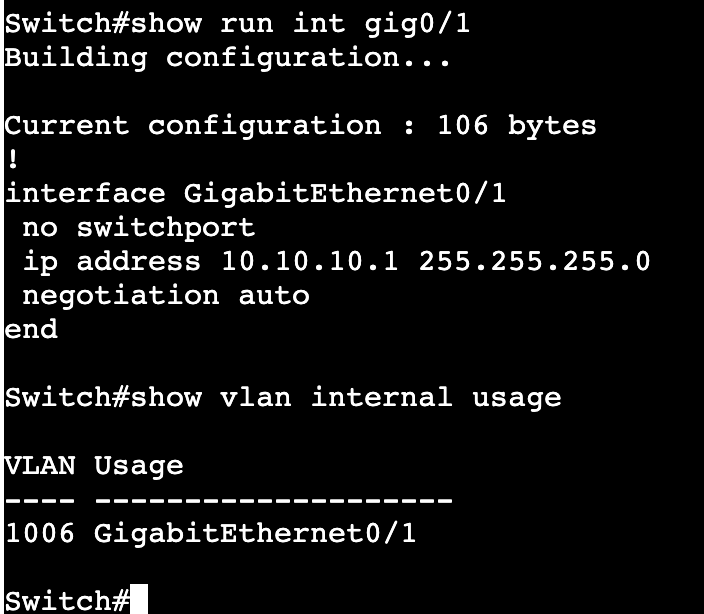
      • ‘show vlan internal usage’
  • The above image shows that when setting up a layer 3 interface with ‘no switchport’, internally one of these reserved IDs are used.
  • vlan internal allocation policy <ascending/descending>
    • Not all platforms do the same by default for reserved internal ID usage. Some go ascending, some go descending by default.
    • Corner case – Change ascending to descending, or vice versa, if a VLAN ID like 4094 needs to be used and there are routed interfaces on switch.

Manual Trunk Pruning:

  • Commands:
    • switchport trunk allowed vlan add <#>
    • switchport trunk allowed vlan remove<#>
    • switchport trunk allowed vlan <#> – This will allow only the number(s) that are added to the command.

Quality of Service

Classification/Marking

  • Way to identify different types of packets and providing different treatment.
  • Classification:
    • ACL
      • Creating ACL specifying source/destination/port.
    • NBAR-Network Based Application Recognition
      • Automatic way of discovering types of traffic traversing router.
  • Marking:
    • Changing header fields.
    • IP packets have the Type of Service field that can be changed.
    • At layer 2, ethernet frames can use 802.1Q priority value.

Queuing/Congestion

  • When a routing device receives packet it will figure out what interface it needs to forward on and sends on its way. If that interface is congested, for example when inbound traffic bandwidth is higher than outbound bandwidth, it will be placed in a queue.
  • Routing devices can have multiple queues with specific amounts of bandwidth allocated to each.
  • Queue Scheduling:
    • Round Robin – Cycles through queues in order, each queue getting fair amount to transmit.
    • Weighted Round Robin – Gives more preference to specific queues.
    • CBWFQ-Class Based Weighted Fair Queueing – Guarantees min bandwidth to each class when there is congestion. Weighted round robin, admin configures weighting as percentage of bandwidth on each interface.
    • Low Latency Queuing – Round Robin is terrible option for voice. Too much delay.
      • LLQ is priority queue that sends traffic immediately instead of waiting for other allocated bandwidth to transmit.
      • Queue Starvation – When priority/LLQ queueing is allocated too much bandwidth. When this happens all other queues begin dropping traffic.

Policing

  • Limits bit rate by dropping traffic.
  • Often used by ISPs to drop customer traffic.
    • Ex. 1Gbps interface connected to customer device, customer only pays for 100Mbps circuit.
    • CIR

Shaping

  • Shaper Queues traffic when going over specific CIR vs. dropping.
  • Creates problem where shaper halts all traffic, then sends, over and over again.
    • Creates a lot of delay.
    • This will break voice traffic.
    • Tc (time interval) of shapers can be configured, breaking up send and wait times more frequently.

MPLS

  • Forwards based on labels instead of L3 destinations.
  • MPLS not much faster than today’s traditional IP forwarding, but MPLS does create less overhead.
  • Can forward any L3 protocols, not just IP.

LSR

  • Label Switching Routers
    • Routers that run MPLS and can receive/transmit labeled packets.

LSP

  • Label Switched Path
    • Entire labeled path through an MPLS Domain.
    • Sequence of routers.
    • Unidirectional.
      • Source to destination and vice versa can be completely different paths.
      • Often return is similar due to routing protocols.

MPLS Header

  • Shim between layer 2 frame and layer 3 packet – hence MPLS L2.5
  • 4 bytes/32 bits.
    • 1st 20 bits – label number
    • 2nd 3 bits – experimental, used for QoS, similar to DSCP.
    • 3rd 1 bit – S field, used to show whether last label in stack.
    • 4th 8 bits – TTL, similar to IP TTL used to discard if reaches 0.

LDP

  • Label Distribution Protocol
    • Uses Multicast to send hellos to other LDP routers, create neighbor adjacency.
    • UDP to discover neighbors. Adjacency built via TCP.
    • Transport Address is what’s used to build the TCP connection for adjacency.
      • Will choose an IP from neighbor router, need to make sure its actually routable in the IGP.
    • LDP generates a label locally for each prefix found in the RIB. Label information is then added to the Label Information Base (LIB).
    • LIB is used to generate info in the LFIB.
    • show mpls ldp bindings
      • shows LIB of MPLS router
    • show mpls forwarding-table
      • shows LFIB of MPLS router.
    • The Label Switched Path (LSP) can be seen through a traceroute on MPLS router.

BGP – Notes

IBGP and EBGP peer relationships:

  • Timers
    • Hold time – 180 seconds
    • Keepalive – 60 seconds
    • Default min time between advertisement runs – 30 seconds
  • Peer Groups
    • R1(config)#router bgp 100
    • R1(config-router)#neighbor <PEER GROUP NAME> peer-group
    • R1(config-router)#neighbor <PEER GROUP NAME> remote-as 100
    • R1(config-router)#neighbor <PEER GROUP NAME> update-source lo0
    • R1(config-router)#neighbor <PEER GROUP NAME> next-hop-self
    • Now apply below:
    • R1(config-router)#neighbor 10.1.1.1 peer-group <PEER GROUP NAME>
    • R1(config-router)#neighbor 192.168.1.1 peer-group <PEER GROUP NAME>
      • Efficient for smaller configurations.
      • Efficient for grouping configuration settings.
  • Session Templates
    • Anything relevant to the session
      • timers, remote-as, update-source, ebgp-multihop
    • R1(config-router)#template peer-session <NAME>
    • R1(config-router)#inherit peer-session <NAME OF ALTERNATE PEERSESSION>
    • R1(config-router)#remote-as 100
    • R1(config-router)#update-source lo0
    • R1(config-router)#exit-peer-session
    • R1(config-router)#neighbor 10.12.12.2 inherit peer-session <NAME>
  • Policy Templates
    • Anything relevant to policy
      • next-hop-self, filter-list; route-map
    • Inheritance is more flexible – inherit from up to 7 templates directly.
    • R1(config-router)#template peer-policy <NAME>
    • R1(config-router)#inherit peer-policy <NAME OF ALTERNATE PEERPOLICY>
    • R1(config-router)#next-hop-self
    • R1(config-router)#route-map <MAP NAME> out/in
    • R1(config-router)#exit-peer-policy
    • R1(config-router)#neighbor 10.12.12.2 inherit peer-policy <NAME>
  • Dynamic Neighbors
    • Allows BGP peering to a group of remote neighbors that are defined by a range of IP addresses.
    • R1(config-router)#neighbor <NAME> peer-group
    • R1(config-router)#neighbor <NAME> remote-as 100
    • R1(config-router)#bgp listen range 10.10.10.0/24 peer-group <NAME>
    • R1(config-router)#neighbor <NAME> transport connection-mode passive
      • Allows routers falling in subnet 10.10.10.0/24 to initiate BGP session with R1.
  • Network Command
    • Classful
      • R1(config)#router bgp 65000
      • R1(config-router)#network 1.0.0.0 – (classful, no mask required)
    • Classless
      • R1(config)#router bgp 65000
      • R1(config-router)#network 11.11.11.0 mask 255.255.255.0
  • Private AS Numbers
    • 64512-65535 – 16 bit numbers
    • 4200000000 – 4294967294 – 32 bit numbers

Cisco Best PATH SELECTION:

  • Highest Weight
  • Highest Local Pref
  • Prefer locally originated
  • Shortest AS_Path
  • Lowest origin type
  • Lowest MED
  • Prefer eBGP over iBGP
  • Lowest IGP metric to the BGP NEXT_HOP
  • Oldest path
  • Lowest Router ID Source
  • Min cluster list length
  • Lowest neighbor address

Well-Known, Mandatory Attributes:

  • AS-Path
  • Origin Code
    • i – IGP
    • e – EGP
    • ? – Redistribution
  • Next Hop Value

Well-Known, Discretionary

  • Local Preference
    • Outbound traffic decisions
    • Default – 100
    • Higher is better
    • iBGP Transmitted, does not pass anywhere else.
  • Atomic Aggregate

Optional, Transitive

  • Aggregator
  • Community

Optional, non-transitive

  • Multi-Exit Discriminator
    • Advertising Metric on prefix information.
    • Lower Value preferred
  • Originator ID
  • Cluster List
  • Cluster ID
  • Weight

OSPF – NOTES

OSPF Neighbor Formation:

  • INIT
    • ACL blocking traffic one way
  • 2-WAY
  • Exstart
  • Exchange
    • MTU Mismatch
  • Loading
  • Full
    • Loading to Full – Desired for neighbor adjacency

Network Types:

  • Point to Point
    • No DR/BDR.
    • Two Devices.
    • Multicast approach – 224.0.0.5 – All SPF Routers Address
    • Automatic network type under HDLC.
    • Hello 10, Dead 40, Wait 40, Retransmit 5
  • Broadcast
    • DR/BDR
      • Eliminates mesh of neighbor adjacencies in multiaccess network.
      • Minimizes number of LSA updates when network changes.
      • 224.0.0.6 – AllDRouters – DR/pseudonode communication
  • Non-Broadcast MultiAccess
    • Legacy Frame Relay
    • DR/BDR – Packets are unicast, not multicast.
  • Point to Multipoint
    • Collection of Point-to-Point links. No DR/BDR
  • OSPF Virtual Link
    • Bandaid for connecting all areas to backbone area 0.

Path Preference:

  • Cost – Sum of all outbound interfaces.
  • Cost can be adjusted by interface
    • router(config-if)#bandwidth <value>
    • router(config-if)#ip ospf cost <value>
      • default reference value is 100Mbps
  • router#show ip ospf border-routers
    • Displays all ABRs and ASBRs.
    • Displays cost to reach prefixes.
  • Path Selection List:
    • 1. Longest prefix/specific match
    • 2. Intra-area routes
    • 3. Inter-area routes
    • 4. E1
    • 5. E2
    • 6. NSSA1
    • 7. NSSA2

LSA Types:

  1. Router – Flooded within Area – Intra
  2. Network – Used by Designated Router. Advises on other adjacencies in multiaccess network.
  3. Network Summary – How prefixes are advertised from one area to another. IA – Inter-Area.
  4. ASBR Summary – Used to identify router that is ASBR.
  5. AS External – Prefixes that come in from ASBR (Redistribution – E1, E2).
  6. Group Membership – Was used for Multicast-OSPF – not really used.
  7. NSSA External – Allows prefixes to be advertised into Not So Stubby Areas.
  8. External Attributes – iBGP alternative – not really used.
  9. – 11 – Opaque LSAs – Opened up OSPF for other applications to include information.

Network Types:

  • Backbone/0:
    • LSA #s – 1, 2, 3, 4, 5
  • Non Backbone, Non Stub:
    • LSA #s – 1, 2, 3, 4, 5
  • Stub:
    • LSA #s – 1, 2, 3
  • Totally Stub:
    • LSA #s – 1, 2
    • LSA # 3 default route only!
  • Not So Stubby Area
    • LSA #s – 1, 2, 3, 4, 7

OSPF OPTIMIZATIONS:

  • ISPF
    • Incremental Shortest Path First calculations
    • Stops entire tree within area from reconverging
    • R1(config-router)#ispf
  • Hello & Dead Timers
    • R1(config-if)#ip ospf hello-interval <# in seconds>
    • R1(config-if)#ip ospf dead-interval <# in seconds>
    • Breaks neighborships until both neighbors match intervals
    • show ip ospf int <interface> – shows the timers on the interface
  • R1(config-router)#max-lsa <#>
    • Number of non-self generated LSAs that this router can keep in database

Prefix Filtering/Suppression:

  • Prefix filter with route map (ex. deny single prefix)
    • R1(config)#access-list 1 permit 1.1.1.0 0.0.0.255
    • R1(config)#route-map <NAME> deny 10
    • R1(config-route-map)#match ip address 1(ACL #)
    • R1(config-route-map)#route-map <NAME> permit 20
    • R1(config-route-map)#end
    • R1(config)#router ospf 1
    • R1(config-router)#distribute-list route-map <NAME> in
      • Feature works inbound on router
    • Only applies to local router. Downstream routers will still have route if they typically would with normal OSPF operations.
  • Filter-List (ex. deny single prefix – LSA Type 3 Filtering)
    • R1(config)#ip prefix-list <NAME> deny 1.1.1.0/24
    • R1(config)#ip prefix-list <NAME> permit 0.0.0.0/0 le 32
    • R1(config)#router ospf 1
    • R1(config-router)#area 0 filter-list prefix <NAME> in
      • Feature works both inbound and outbound.
  • Route Poisoning
    • R1(config)#access-list 1 permit 1.1.1.0 0.0.0.255
    • R1(config)#router ospf 1
    • R1(config-router)#distance 255 0.0.0.0 255.255.255.255 1(access-list number)
    • Makes route look unreachable – AD of 255
  • Internal or Area Summarization
    • ON ABR:
      • R1(config-router)#area 10 range 1.0.0.0 255.0.0.0
      • Summarization for inter-area routes
  • External Summarization
    • ON ASBR:
      • R1(config-config)#summary-address 1.0.0.0 255.0.0.0

EIGRP – Notes

PACKET TYPES:

  • Hello/Ack
    • Neighbor Discovery
    • Multicast advertised on segment, and Unicast responses are returned.
    • Hello with no Data is Ack.
    • Also Keepalive.
  • Updates
    • Conveys reachability information for each destination.
    • Sent reliably.
  • Queries
    • Sent out to search for another path during convergence.
    • Multicast looking for missing prefix.
  • Replies
    • Sent in response to Query, brings prefix from active back to passive (good).
    • Sent reliably.
  • Request
    • Used to obtain specific information from neighbor.

Stuck in Active:

  • EIGRP router goes into SIA state and removes neighbor adjacency if it does not receive response to query after 3 minutes.
  • Continues propagation of query traffic across EIGRP domain.
  • Condition where EIGRP router goes active for specific route by sending query, but never receives a reply.

EIGRP Graceful Shutdown

  • Enabled by Default
  • Neighbor will receive ‘PEER-TERMINATION’ message, implies EIGRP was turned off on interface, do not wait for hold timers.
  • Does not work with an interface shutdown. Has to be removal of EIGRP interface or process.

EQUAL COST LOAD BALANCING:

  • Multiple paths in RIB for same destination prefix – ECMP

UNEQUAL COST LOAD BALANCING:

  • Installation of both successor routes and feasible successors into the EIGRP RIB.
  • Variance value can be modified to enable this feature. Variance value is the FD (best available route metric – successor) multiplied by the variance multiplier.
    • Any feasible successor’s FD with metric below EIGRP variance value is installed into RIB.
    • Feasible Successor needs FD to be less than successor route multiplied by variance value.

EIGRP Stub Routing:

  • Stub router will advertise all connected and summary routes to upstream EIGRP speakers (Default).
  • Stub router never gets queried by upstream EIGRP speakers for route information.
  • Helps with using branch as traversal for link failure.
  • Branch(config-router)#eigrp stub (default advertise connected and summary)

EIGRP Finite State Machine:

  • All the states and processes that DUAL uses to compute metrics and routes.
  • Passive route states equate to a stable network and no re-computation being needed by DUAL.
  • Active route states equate to DUAL re-computing metrics and/or locations for routes.
    • No feasible successor begins query to EIGRP neighbors.

EIGRP Add Path:

  • DMVPN Feature
  • Allows for load balancing traffic between two spokes over EIGRP.
  • By default a hub will not advertise more than one route to a spoke destination, even if the hub has two equal cost paths. If a spoke lost a primary route EIGRP would have to reconverge.
  • Configure:
    • HubRouter(config)#router eigrp NAMEMODE
    • HubRouter(config-router)#address-family ipv4 unicast autonomous-system 1
    • HubRouter(config-router-af)#af-interface tunnel1
    • HubRouter(config-router–af-interface)#add-paths <number of paths>

EIGRP LOOP FREE ALTERNATE FAST REROUTE

  • Allows for taking a backup path in the network within 50ms
  • Installs both the Successor and Feasible Successor in the routing table, not just successor. Lowers failover time.
  • Interior Gateway Protocols calculate LFAs using 2 methods:
    • Per-Link:
      • Found in multiaccess segments.
      • All links use the same next hop address.
      • Single secondary backup link.
      • Less CPU and simple to calculate.
    • Per-Prefix
      • Calculates LFA for each destination.
      • Enforces FRR or failover uses two different backup routes or next hops.
  • If there are multiple LFAs then FRR needs to choose one. List of tie breakers below, lower metric wins:
    • Interface Disjoint
      • Do not choose an LFA that goes out the same interface – 20
    • Linecard Disjoint
      • Do not select LFA that exits out same line card – 40
    • Lowest Repair Path Metric
      • Choose LFA with lowest metric – 30
    • Shared risk Link Group (SRLG)
      • Prefer LFA not sharing the same Share Link Group

EIGRP Summary Leak Map

  • Advertises more specific route(s) on interface in addition to summary.
    • 1 – Create access list
      • R1(config)#ip access-list standard Leak
      • R1(config-std-nacl)#permit 10.30.1.0 0.0.0.255
    • 2 – Create Route Map referencing access list
      • R1(config)#route-map Leak-Example 10
      • R1(config)#match ip address Leak
    • 3 – Use summary command under interface
      • R1(config)#interface Gig0/2
      • R1(config-if)#ip summary-address eigrp 1 10.30.0.0/16 leak-map Leak-Example
  • In the routing table of neighbor there is now a summary address (10.30.0.0/16) and a longer prefix route of 10.30.1.0/24

EIGRP Stub

  • Typical EIGRP configuration for branch routers.
  • Way to stop queries from being sent to a router when there are topology changes or links going down.
  • Types of EIGRP Stub networks:
    • Redistribute – Stub router can advertise redistributed routes.
    • Summary – Stub router can advertise summary routes.
    • Connected – Stub router can advertise directly connected.
    • Static – Stub router can advertise redistributed static routes.
    • Receive-only – Stub router does not advertise any networks, only receives.
  • Default ‘eigrp stub’ command uses connected and summary.

EIGRP Stub Leak-Map

  • Similar to EIGRP Summary leak map, allows router to be configured as stub but still have exceptions for routes being advertised.
  • R1(config)#router eigrp 1
  • R1(config-router)#eigrp stub leak-map <name of created route-map>